
Most of us don't need a six-seat dining table every Tuesday. Then friends come over, someone brings a partner, and the little table that usually feels perfect suddenly looks optimistic.
That's the appeal of an extendable dining table: a manageable everyday size with extra room when you need it. They're a familiar part of current furniture ranges, from compact apartment tables to larger designs made for hosting. But the clever opening mechanism is only part of the story.
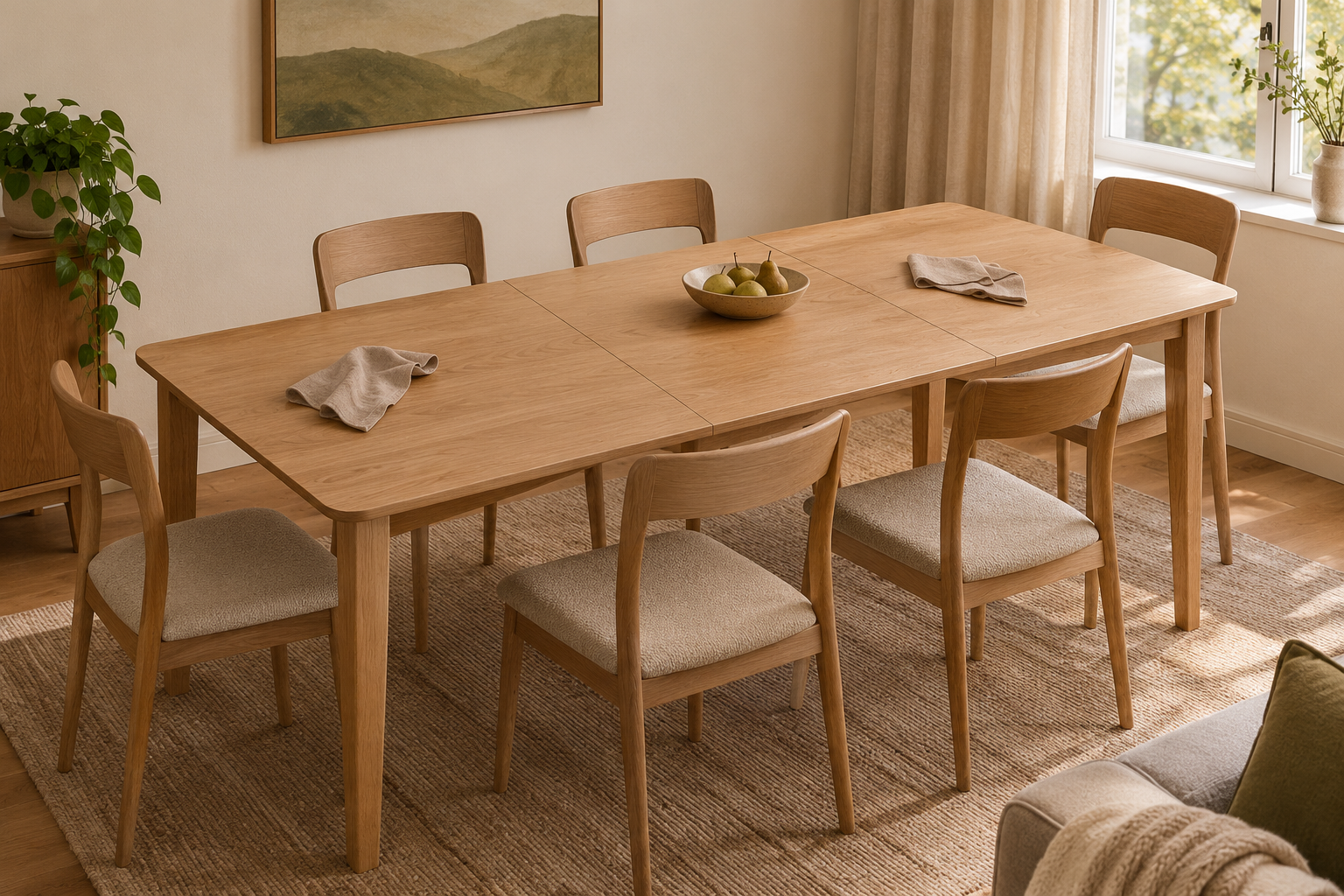
At Hometios, making panel furniture has made us quite interested in the bits underneath a tabletop. When you're buying for your own home, those details translate into everyday questions: where does the extra panel live, can you open the table comfortably, and does anyone end up with a table leg between their knees?
First, work out how often you'll actually extend it
If you host most weekends, an easy opening action and convenient leaf storage deserve a high place on your list. If you need extra seats twice a year, you might accept a separate leaf that lives in a cupboard.
And if the table will stay extended almost permanently? Compare a fixed table of the same size before paying for a feature you rarely use.
Be honest about the extra chairs, too. A table that grows from four places to six doesn't solve where those other two chairs will live for the rest of the week.
Where does the extra piece go?
The extra section of tabletop is usually called a leaf. Its storage arrangement can matter more than the headline seat count.
| Table type | What you do | What we'd check |
|---|---|---|
| Separate drop-in leaf | Open the table and fit a removable panel. | Where the panel will be stored, its weight and whether moving it is comfortable. |
| Self-storing leaf | Retrieve the extension from within or beneath the table. | How easily you can reach it and whether the storage structure affects legroom. |
| Butterfly leaf | Unfold a hinged extension from its stored position. | The lifting and folding action, clear instructions and room to keep fingers away from moving joints. |
| Drop-leaf or gateleg table | Raise a hinged side and engage its support. | How the support locks into place and where it sits relative to the chairs. |
There are useful real-world examples of the difference. IKEA lists the compact TONSTAD extendable table with a leaf stored beneath the top, and describes its legs as remaining at the corners when extended. West Elm's Mid-Century Extendable Dining Table uses an included drop-in leaf that stores separately.
Those two arrangements suit different homes. If every cupboard is already full, storage inside the table could be the feature you appreciate most. Check the exact size and version you're considering, because a range name alone doesn't tell you every detail.
Measure the dinner party, not just the tabletop
Mark both the closed and extended table outlines on the floor with removable tape. Then put actual chairs around the larger outline, sit down and pull them back as you would when getting up.
Can someone walk behind a seated guest? Can you still open the fridge, reach the balcony or pull out a sideboard drawer? A table can technically fit inside a room while making the room frustrating to use.
Here's a simple example. A 120 cm table with a 40 cm extension becomes 160 cm long. That's another 40 cm of tabletop in the room, before accounting for any change in chair position. Check where that extra length goes; different mechanisms move different parts of the table.
Remember the rug and pendant light as well. You may like the table centred beneath the light every day, but need to reposition it for guests. Think through that move before delivery day.
“Seats six” is a starting point
Six slim chairs and six broad chairs with arms are very different arrangements. So are a quick lunch and a long dinner with serving dishes in the middle.
Look at the distance between the legs, the height beneath the frame and any central supports. Check both table positions. A base that feels generous when the table is closed may put a support right where the extra chair needs to go.
Take your chair measurements shopping. If possible, sit at the end position as well as the side. We would happily choose a table advertised for fewer people if everyone could sit comfortably at it.
The opening action should suit you
A quick product video can make almost any mechanism look effortless. Ask to see the whole process: clearing the top, releasing any catches, opening it, positioning the leaf and securing it again.
If you'll normally set up dinner alone, check whether the maker intends the table to be operated by one person. Don't assume “easy to extend” means that a heavy leaf is comfortable for you to lift.
On a showroom sample, ask to check that the sections meet neatly and the securing hardware works as instructed. Once correctly set up on a level floor, the top should feel reassuring during normal use. A persistent wobble, a sticking action or a noticeably raised join is worth asking about before buying.
What would a furniture maker look at underneath?
We'd look at how the extension runners attach to the frame, how the additional section is supported and how clearly the assembly instructions explain the moving parts. We'd also ask whether replacement fittings are available.
The material description deserves a proper read. “Oak finish,” “oak veneer” and “solid oak” describe different things. An attractive wood surface doesn't, by itself, tell you what the whole top or base is made from.
A well-made panel construction can be a sensible choice; we wouldn't judge a table by the material name alone. We would want a clear description of the top and frame, care instructions we can live with, and cleanly finished edges around the extension.
For daily life, placemats, suitable heat protection and prompt spill cleanup are more useful than assuming any finish is indestructible. Follow the table's own care guidance, including how to store a removable leaf so its surface and edges stay protected.
Round-to-oval or rectangular?
A round table that becomes oval can be appealing in a compact dining corner: you get a softer outline for everyday use and extra length for guests. Still, check the base in both positions. A pedestal takes up space under the table even if there are no corner legs.
A rectangular design may be easier to line up with a wall, bench or long narrow room. Neither shape automatically seats more people comfortably. Let the room layout and your chairs settle the argument.
So, is an extendable table worth it?
Yes, when the smaller size improves everyday life and the larger size fits comfortably when you need it. We'd prioritise easy operation, a sensible home for the leaf and comfortable seats over the largest possible guest count.
If you're still weighing up the room as a whole, browse the Hometios kitchen and dining collection for other furniture layouts to compare. For the extendable table itself, keep one final question in mind: would you be happy opening it on an ordinary Friday evening, with dinner almost ready? That's the version of “flexible living” that actually matters.